
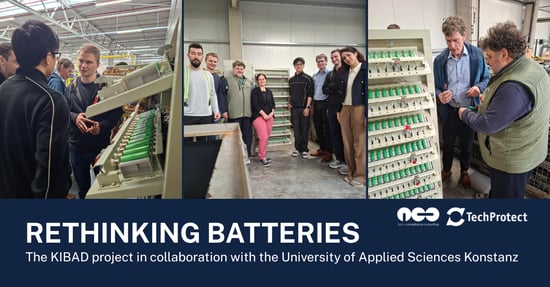
At the beginning of March, an exciting new initiative was launched with the KIBAD project (AI-based Battery Data Analysis), actively supported by our sister company TechProtect GmbH. In collaboration with the Konstanz University of Applied Sciences, the project aims to elevate the use of battery data to a new level, with the goal of sustainably strengthening second-life applications and the circular economy.
The project is funded by the German Federal Ministry for Economic Affairs and Energy (BMWE) and managed by VDI/VDE Innovation + Technik GmbH as the project sponsor.
Kick-off in Holzgerlingen: A Strong Start to Collaboration
The official project launch on 1 March 2026, marked the beginning of an intensive collaboration. Together with the Konstanz University of Applied Sciences for Technology, Business and Design, under the scientific leadership of Prof. Johannes Reuter and the industry partner, TechProtect (Armin Kienle), our sister company will work over the next two years on developing an AI-driven platform.
The kick-off meeting primarily served to align all partners and establish a shared understanding of objectives and approach. It quickly became clear how valuable the combination of perspectives from academia and industry is, united by the shared goal of making battery data more usable.
The project is further supported by additional contributors from industry and research, as well as students from the university who are actively involved in implementation and research.
Why Battery Data Matters
In many projects, we see that the potential of battery data is far from being fully utilised. This is exactly where KIBAD comes in.
The idea: a platform that uses both real-world field data and test data from battery cells to generate increasingly reliable results for battery cell data sheets via advanced algorithms. Using machine learning, factors such as charge cycles, capacity degradation, and thermal influences are analysed and continuously refined as more data becomes available.
The goal:
- Realistic predictions of remaining useful life
- Well-founded assessment of the cell (State of Health, SOH)
- Decision support for recycling or reuse
- Data sheets for second-life applications of battery cells
From Isolated Data to Real Solutions
What makes KIBAD particularly exciting is a focus on open and interoperable data structures. Instead of isolated solutions, the goal is to build an infrastructure that can be used by a wide range of stakeholders – from manufacturers to recyclers.
This is becoming increasingly important considering growing regulatory requirements. Without reliable data, it will be increasingly difficult not only to ensure compliance but also to implement it efficiently. The aim is not just to meet regulatory standards but to actively exceed them through a data-driven approach and set new benchmarks for used battery cells.
A Step Toward a Circular Economy
KIBAD is more than just a research project. It represents a concrete step toward a circular economy that prioritises reuse over recycling, enabled by data analysis, to effectively moving higher up the waste hierarchy (Reduce – Reuse – Recycle – Disposal).
TechProtect contributes its practical, industry-focused perspective, particularly at the intersection of regulation, data, and operational implementation. This is complemented by the Konstanz University of Applied Sciences, which brings its expertise in research and fuzzy algorithms. The shared goal is to develop solutions that are not only technologically sound but also market viable.
The project will run until February 2028. We will regularly share updates and insights along the way, from kick-off and initial results to concrete use cases.


