
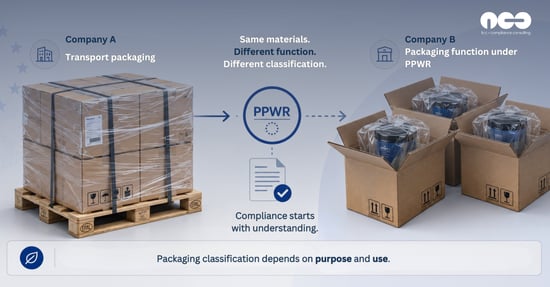
The question of what actually qualifies as packaging under the new EU Packaging and Packaging Waste Regulation, the PPWR, is less straightforward than it may seem at first glance.
The new European packaging regulation has already entered into force and will begin to apply in all Member States in August of this year. It introduces numerous new requirements and obligations for packaging to be considered compliant. In particular, sustainability requirements will be implemented gradually. We will certainly address this topic in further posts.
Article 3 of the PPWR defines what is meant by “packaging.” It is already clear from this provision that the definition goes beyond a mere description of materials intended to contain, protect or handle products, or to deliver or present products to another economic operator or to a final user.
A few weeks ago, the European Commission published guidance that aims to clarify, through practical examples, how the rules of Article 3 should be interpreted. One aspect is particularly noteworthy: when assessing whether an item qualifies as packaging, it is not only the material itself that matters, but also the purpose and the specific way in which it is used.
This may sound like a highly technical detail. In practice, however, it has significant consequences. The classification not only determines whether certain material requirements apply at all. It also affects which role a company assumes under the PPWR: am I a supplier, a manufacturer, or possibly a producer?
Depending on the answer, the resulting obligations may differ considerably.
A practical example
Company A sells cardboard boxes to Company B.
In principle, cardboard boxes are often used to transport or protect products. Company B will later use these boxes to package its own products.
Company A packages the cardboard boxes for transport. They are placed inside a larger box, wrapped in transparent plastic film, secured with plastic straps, and placed on wooden pallets.
After Company B receives the delivery in an EU Member State, it removes this transport packaging. Company B then wraps its own products in plastic film, places them inside the cardboard boxes, and sells them in the country in which it operates.
Who is the manufacturer in this case under the PPWR?
Would it be correct to say that Company A is the manufacturer of all packaging, including the cardboard boxes it sold?
Clearly, no.
At first glance, Company A is indeed the manufacturer of the materials it used for shipment. For this transport packaging, Company A must therefore comply with the obligations associated with this role.
The situation is different for the cardboard boxes themselves.
At the time of the sale from Company A to Company B, the cardboard boxes did not yet fulfil a packaging function within the meaning of the PPWR. Between A and B, they were not yet to be classified as packaging. Company A therefore cannot be considered the manufacturer of those cardboard boxes, and certainly not the producer. Company A is only the manufacturer of the materials it used to package the cardboard boxes for shipment.
The assessment changes once Company B uses the cardboard boxes to package and distribute its own products. At that point, the cardboard boxes meet the PPWR definition of packaging. From that moment onward, the corresponding PPWR obligations relating to those boxes also arise, making company B the producer of these cardboard boxes.
To determine these obligations correctly, it is necessary to carefully assess which economic operators assume which roles in the specific arrangement.
The allocation of roles in this example
As a result, Company B becomes the manufacturer of the cardboard boxes in this case. The same applies to the plastic film it uses to package its own products.
Company A, however, is not entirely outside the scope of the PPWR. With regard to the cardboard boxes, Company A should be classified as a supplier. This role also entails responsibilities, although they are less extensive than those of the manufacturer.
At the same time, Company A cannot simultaneously hold the status of producer with regard to these cardboard boxes. The definition of producer under the PPWR is complex enough to deserve a separate post.
In summary:
Company A is the manufacturer of the packaging materials it used to send the cardboard boxes to Company B. At the same time, Company A is the supplier of the cardboard boxes themselves.
Company B is the manufacturer of the materials it uses to send its own products to its customers. This includes the cardboard boxes and the plastic film.
Why this classification matters
This example clearly shows that the everyday understanding of what packaging is cannot simply be applied automatically under the PPWR. What matters is not only the material itself, but also the specific context in which it is used.
Errors in classification can have significant consequences for companies. A company that does not correctly determine its role as an economic operator risks fulfilling the wrong obligations or overlooking important ones altogether. Since each role under the PPWR carries specific responsibilities, incorrect classification can quickly lead to compliance risks.
The specific sanctions will be determined at national level. Nevertheless, it is already clear that violations may have a noticeable impact on companies.
A good starting point is therefore to ask these two questions:
- Am I really dealing with packaging within the meaning of the PPWR?
- Which role do I assume in relation to this specific packaging?
Answering these questions carefully creates the basis for correct classification and for robust compliance under the PPWR.


