
29
Sep 2026
Reverse Logistics: Key Terms Explained Simply
On 29 , Sep 2026 | In | By Laura Reinhard
Returns, repairs, take-back schemes or recycling: products do not always simply move from the company to the customer. In many cases, they make their way back again. This is where reverse logistics comes in. The term covers all processes in which products, materials or packaging are returned from the customer to the retailer, manufacturer or a ...
24
Sep 2026
PPWR Action Required – What Comes Next?
On 24 , Sep 2026 | In | By Alisa Maier
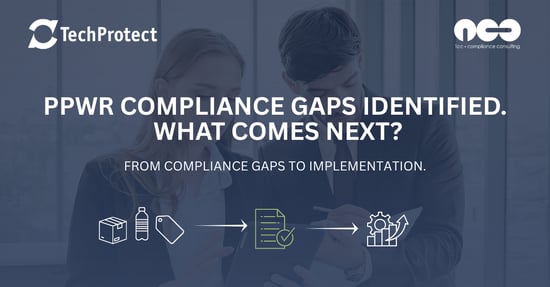
Which PPWR requirements apply to our company? Being able to answer this question provides an important foundation. The company’s exposure has been assessed, relevant requirements and responsibilities are understood, and the first areas where action may be needed are becoming visible. But clarity about the current situation alone does not create ...
22
Sep 2026
PPWR Is Now Applicable: Do You Know What It Means for Your Business?
On 22 , Sep 2026 | In | By Mona-Fee Kienle
%20(22)-1.png?width=550&name=1cc%20Blog%20(1200%20x%20628%20px)%20(22)-1.png)
Since 12 August 2026, the EU Packaging and Packaging Waste Regulation (PPWR) has generally applied across the European Union. This means that the PPWR is no longer a regulatory issue for the future, even though certain requirements will become applicable gradually at later dates. For companies placing packaging or packaged products on the EU ...
17
Sep 2026
How can you formulate environmental claims and avoid greenwashing?
On 17 , Sep 2026 | In | By Tatjana Möllmann
The requirements of ‘Directive (EU) 2024/ 825 of the European Parliament and of the Council of 28 February 2024 amending Directives 2005/29/EC and 2011/83/EU as regards empowering consumers for the green transition through better protection against unfair practices and through better information will be mandatory from 27 September 2026. It is ...
15
Sep 2026
Reverse logistics vs. traditional logistics: what’s the difference?
On 15 , Sep 2026 | In | By Alisa Maier
Storing, picking, packing, dispatching and finally delivering products to the customer: traditional logistics often follows clearly defined and easily plannable processes. But what happens when a product has to take the opposite route? This is where reverse logistics comes into play. Returns logistics is an important part of this. It involves much ...
10
Sep 2026
EU Directive on the ‘Right to Repair’: What do I need to know?
On 10 , Sep 2026 | In | By Tatjana Möllmann
The EU Directive on the ‘Right to Repair’ (Directive (EU) 2024/1799) is primarily aimed at reducing the premature disposal of functional products and creating incentives for consumers to have faulty products repaired. Member States must apply the relevant requirements from 31 July 2026. Within the statutory warranty period, a product should be ...
08
Sep 2026
Logistics in the circular economy model: what matters
On 08 , Sep 2026 | In | By Mona-Fee Kienle
%20(21)-1.png?width=550&name=1cc%20Blog%20(1200%20x%20628%20px)%20(21)-1.png)
Manufacturing, selling, using and, ultimately, the disposal of products: this linear model is increasingly reaching its limits. In a circular economy, products and materials should instead remain in the economic cycle for as long as possible. Reuse, repair, refurbishment, and recycling play a central role in this. The European Environment Agency ...
03
Sep 2026
The operational launch for industrial and commercial packaging in France has been postponed to 1 January 2027
On 03 , Sep 2026 | In | By Tatjana Möllmann
%20(23)-1.png?width=550&name=1cc%20Blog%20(1200%20x%20628%20px)%20(23)-1.png)
The French Ministry for the Environment has announced the new deadline for the implementation of the extended producer responsibility for industrial and commercial packaging. According to a press release, the operational launch of the scheme has been postponed to 1 January 2027. In explaining the decision, the Ministry reiterates reasons ...
01
Sep 2026
Implementing demo programmes efficiently: How the process works.
On 01 , Sep 2026 | In | By Mona-Fee Kienle
%20(25)-1.png?width=550&name=1cc%20Blog%20(1200%20x%20628%20px)%20(25)-1.png)
Products are most convincing when customers experience them for themselves. This is where demo programmes come in: prospective customers can test a product under real-world conditions before making a purchase decision. For manufacturers and suppliers, however, this can quickly become a complex process: from registration and verification, through ...